MCB vs MCCB vs ACB: Differences, Applications and Selection Guide
Choosing a circuit breaker becomes easier when you start with its job. A workshop lighting circuit, a machine feeder and a factory’s main incoming supply have different protection requirements. Selecting only by price or ampere rating can leave important checks incomplete.
Ahmedabad Electrical Corporation, with Lauritz Knudsen supply through Reliable Electrical, our distributor associate, supports contractors, panel builders, OEMs and traders with genuine Lauritz Knudsen electrical products, widely searched as L&T switchgear. We offer selected ready stock, bulk procurement and delivery across Gujarat and India.
Which circuit breaker should you choose?
Breaker Typical application Main selection priority
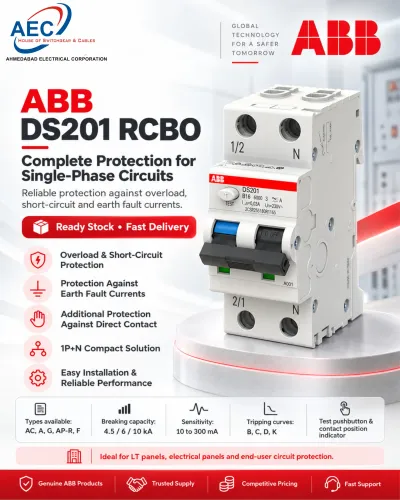
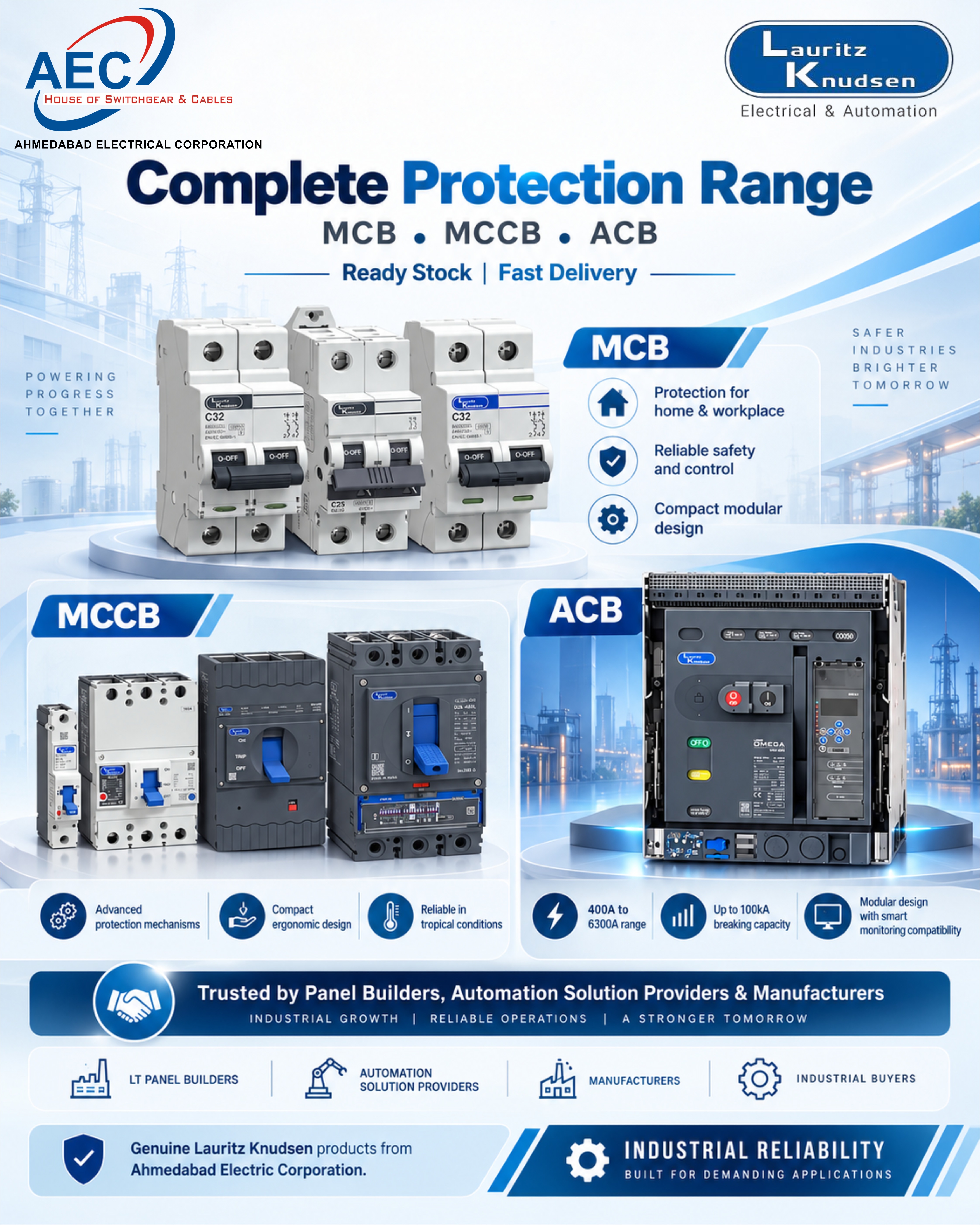
MCB — Miniature Circuit Breaker Lighting, socket circuits and smaller auxiliary loadsCurrent rating, trip curve and breaking capacity
MCCB — Moulded Case Circuit Breaker Machine feeders, sub-distribution and industrial incomers Fault level, protection settings and coordination
ACB — Air Circuit Breaker Main LT incomers, bus couplers and major distribution feeders Selectivity, short-time withstand and maintenance access
These applications overlap. The final choice depends on electrical calculations and operating requirements, rather than a universal current cutoff.
Choose an MCB for smaller branch circuits
An MCB is a practical starting point for appropriately rated lighting, socket and control-supply circuits. Its compact modular construction suits distribution boards where installation space matters.
- Check the circuit current and cable capacity.
- Match the trip curve to load characteristics and starting current.
- Confirm breaking capacity at the installation point.
Lauritz Knudsen lists AU, Exora and Tripper MCB ranges. An ordinary MCB provides overcurrent protection; earth-leakage protection requires an appropriately selected RCCB, RCBO or other suitable arrangement.
Choose an MCCB for industrial feeders
Consider an MCCB when the application needs greater current capacity, suitable fault interruption or configurable protection beyond the selected MCB’s capabilities.
- Suitable applications include machine supplies and distribution feeders.
- Thermal-magnetic and electronic protection options depend on the model.
- Frame size, release rating and actual protection settings are separate considerations.
Lauritz Knudsen offers Dsine DN, Dsine DZ, DY and DU ranges. Although designed for demanding environments, each installation still needs its applicable temperature and derating checks.
Choose an ACB for main distribution requirements
An ACB is worth evaluating for a factory’s main incomer or bus coupler when coordination, serviceability and advanced protection are priorities.
Lauritz Knudsen’s ACB portfolio includes C Power and U-Power OMEGA, with a stated range of 400–6300 A and breaking capacities up to 100 kA at 415 V, depending on configuration.
- Choose fixed or draw-out construction according to maintenance needs.
- Specify manual or electrical operation and required accessories.
- Confirm protection, monitoring and communication features individually.
These maximum ratings are portfolio limits, not specifications shared by every model.
A practical example for a GIDC workshop
One installation can use all three categories: an ACB at the main LT board, MCCBs supplying production sections, and MCBs protecting lighting or auxiliary circuits. A smaller factory may use an MCCB as its main incomer. The correct arrangement follows the installation’s requirements.
Before ordering, check:
- Load and cables: Coordinate the protection setting with demand and conductor capacity.
- Fault current: Confirm suitable breaking capacity at the actual system voltage.
- Selectivity: Check whether a downstream fault can be cleared without unnecessarily disconnecting the whole plant.
- Installation: Verify poles, neutral requirements, dimensions, terminals and enclosure conditions.
Useful product references for your enquiry
Include exact catalogue numbers for faster quotation matching:
- CM92005OOMOOG: Dsine DN2-250N, 160 A, three-pole thermal-magnetic MCCB.
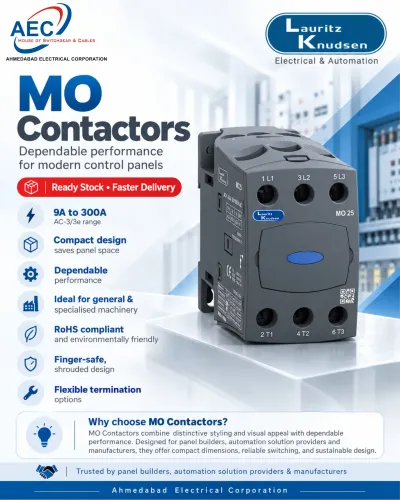
- CS97017BOOO: MCX 22 four-pole contactor with a 240 V AC, 50 Hz coil.
These are separate product examples, not a pre-coordinated assembly. Ask us to check accessories, compatibility and current availability against your BOM.
Supply across Gujarat’s industrial locations
We support enquiries from major cities and smaller industrial estates, including:
- Ahmedabad: Vatva, Naroda, Odhav, Kathwada, Sanand and Dholka.
- North Gujarat: Chhatral, Kalol, Kadi, Dediyasan, Gozaria and Kukerwada.
- Vadodara: Makarpura, Nandesari, Savli, Waghodia and Por Ramangamdi.
- Bharuch: Ankleshwar, Panoli, Jhagadia, Dahej, Saykha and Palej.
- Surat: Sachin, Pandesara, Ichhapor, Hazira and Bardoli.
- South Gujarat: Vapi, Sarigam, Umbergaon, Gundlav and Bilimora.
- Central Gujarat: Halol, Godhra, Nadiad and Vithal Udyognagar.
- Rajkot–Morbi: Aji, Metoda, Kuvadva, Gondal, Rafaleshwar and Wankaner.
- Saurashtra: Jamnagar, Dared, Junagadh, Porbandar, Bhavnagar and Sihor.
- Other locations: Wadhwan, Halvad, Gandhidham, Anjar, Bhuj, Palanpur and Himmatnagar.
Ready stock, clear quotations and fast delivery
Our delivery targets are 4–5 days within Gujarat and 5–6 days to major Indian metros, subject to confirmed stock, order acceptance and transport availability. Special configurations receive separate lead times.
MCB vs MCCB vs ACB: 10 FAQs for Lauritz Knudsen (L&T) Switchgear Buyers
1. What is the difference between MCB, MCCB and ACB for industrial electrical panels?
- MCBs typically protect smaller branch circuits, MCCBs protect machine feeders and distribution circuits, and ACBs serve major incomers and bus couplers. Select according to load, fault level, protection requirements and maintenance needs—not ampere rating alone.
2. Which Lauritz Knudsen MCB should I choose for workshop lighting and socket circuits?
- Consider AU, Exora or Tripper MCB ranges, matching current rating, poles, trip curve and breaking capacity to the circuit. Ordinary MCBs protect against overloads and short circuits; earth-leakage protection requires an appropriate RCCB or RCBO arrangement.
3. When should a panel builder choose an MCCB instead of an MCB?
- Choose an MCCB when the application requires current capacity, fault interruption or protection adjustments beyond the selected MCB’s capabilities. Lauritz Knudsen offers Dsine DN, Dsine DZ, DY and DU ranges for different requirements.
4. When is a Lauritz Knudsen ACB suitable for a factory’s main LT panel?
- Consider an ACB where main distribution needs selectivity, maintenance access or advanced protection. LK’s portfolio covers 400–6300 A, with breaking capacities up to 100 kA at 415 V, depending on configuration. Fixed and draw-out options support different installation needs.
5. How do I select the correct breaker frame size and current rating?
- Calculate demand, check cable capacity and account for panel temperature and applicable derating. Frame size, trip-unit rating and protection settings are different specifications. Share your load schedule and panel drawing before ordering; a larger frame alone does not establish correct protection.
6. What breaking capacity should an industrial MCB, MCCB or ACB have?
- Match the applicable breaking-capacity rating to the prospective short-circuit current at the installation point and actual system voltage. For MCCBs and ACBs, check Icu and Ics; where delayed protection is required, also verify short-time withstand capability and coordination.
7. Can I replace an existing L&T breaker with a Lauritz Knudsen breaker of the same amperage?
- Check the exact replacement reference, dimensions, terminals, poles, fault rating and trip characteristics first. Send photographs of the existing nameplate and connections. Equal ampere ratings do not guarantee that the replacement will fit or coordinate correctly with other protection devices.
8. How can OEMs and traders order genuine Lauritz Knudsen switchgear in Gujarat?
- Send your BOM, catalogue numbers, quantities, accessory requirements and delivery PIN code to Ahmedabad Electrical Corporation, with LK supply coordinated through Reliable Electrical, our distributor associate. Request an itemised quotation, invoice and applicable warranty terms.
9. Do you deliver MCBs, MCCBs and ACBs to Gujarat’s major GIDC estates?
- We serve buyers in Ahmedabad—Vatva, Naroda and Odhav; Sanand; Chhatral, Kalol and Kadi; Vadodara—Makarpura and Savli; Surat—Sachin and Pandesara; Ankleshwar, Dahej, Vapi and Sarigam, alongside Rajkot, Jamnagar, Bhavnagar and Kutch. Confirm your estate address and transport availability when ordering.
10. Why choose Ahmedabad Electrical Corporation for ready stock and fast switchgear delivery?
- We offer genuine-product sourcing through Reliable Electrical, selected ready stock and consolidated panel-material procurement. Delivery targets are 4–5 days within Gujarat and 5–6 days to major Indian metros, subject to confirmed stock, order acceptance and transport availability. Special configurations receive separate lead times.
Need the right breaker for your panel? Share your load details, fault level, required quantity and delivery location with Ahmedabad Electrical Corporation for a specification-based quotation.
Send your BOM, load details, fault level and delivery PIN code to Ahmedabad Electrical Corporation. Request a quotation with exact references, GST, freight and dispatch commitments—so your panel material arrives with the specifications your project needs.
Keywords