L&T Three Phase Energy Meter Connection Diagram
L&T Three Phase Energy Meter Connection Diagram: A Practical Guide for Gujarat Buyers
Accurate energy measurement begins with selecting the right meter and connecting it according to its specific configuration. For contractors, OEMs and electrical panel manufacturers, understanding an L&T three phase energy meter connection diagram helps prevent incorrect purchases, commissioning delays and misleading readings.
Ahmedabad Electrical Corporation, with Lauritz Knudsen supply coordinated through Reliable Electrical, our distributor associate, supports genuine switchgear and metering-product procurement across Gujarat and India. From workshop submetering to industrial distribution panels, we help buyers prepare clear requirements before ordering.
EM101+ or ER300P: which meter fits your application?
These product families serve different requirements:
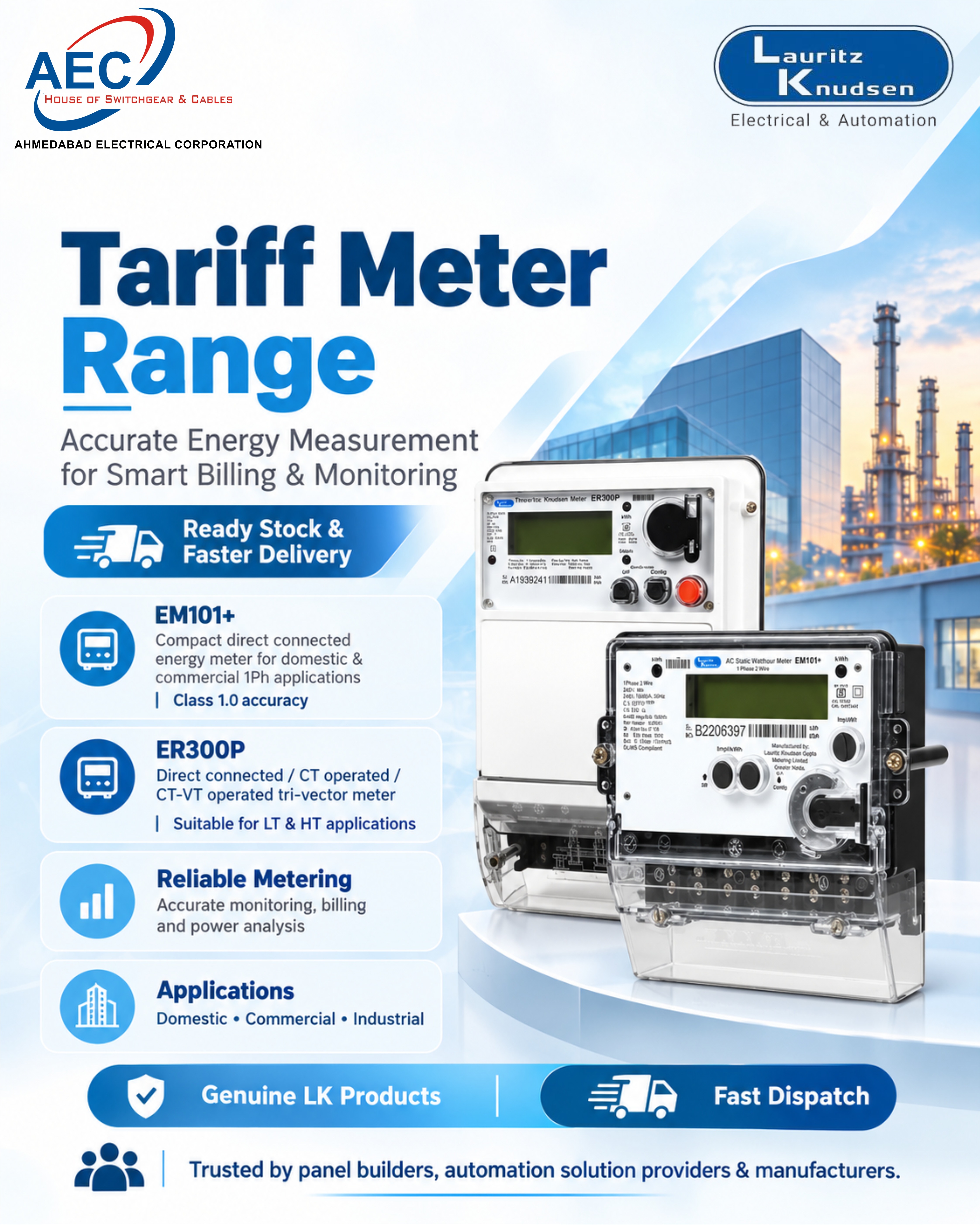
- EM101+: A compact, direct-connected meter for single-phase domestic and commercial applications. It is intended for single-phase, two-wire operation.
- ER300P: A tri-vector metering family offering direct-connected, CT-operated and CT–VT-operated versions for different LT and HT applications.
For a three-phase requirement, evaluate the appropriate ER300P variant. EM101+ should not be selected simply because it appears alongside ER300P in a product brochure.
Understand the three connection arrangements
Choosing the correct arrangement is more important than copying a diagram found online.
- Direct-connected metering: Load current passes through the meter’s current-carrying paths, within its specified rating.
- CT-operated metering: Current transformers provide scaled current signals to compatible meter inputs.
- CT–VT-operated metering: Current and voltage transformers provide the measurement signals required by the selected configuration.
The ER300P family includes accuracy-class options such as 1.0, 0.5S and 0.2S, alongside features including a backlit display, anti-tamper functions and multi-tariff/time-of-day capability. Confirm these against the ordered version.
How to read the three-phase connection overview
The accompanying white-background image illustrates a three-phase, four-wire direct-connected concept:
- L1, L2 and L3 represent the three phase conductors.
- N represents the neutral connection.
- Incoming and outgoing paths show the relationship between supply, meter and load.
- Protective earth continues separately to the panel and equipment earthing system.
The illustration intentionally omits terminal numbers. Their allocation must come from the exact meter’s terminal-cover diagram or manufacturer documentation. A CT-operated meter must not be wired using a direct-connected arrangement.
Upstream isolation and suitable circuit protection remain necessary. The meter measures energy; it does not replace a circuit breaker.
Checks before wiring and commissioning
Ask your qualified electrical installer to verify:
- System configuration: Single-phase or three-phase, and three-wire or four-wire.
- Electrical ratings: Meter voltage, frequency and direct-current rating or instrument-transformer inputs.
- Phase association: Each current input must correspond to the correct voltage phase.
- Transformer details: CT/VT ratios, polarity, accuracy and burden where applicable.
- Meter configuration: Programmed ratios, displayed quantities and any applicable multiplying factor.
- Installation documentation: Approved diagram, terminal tightening requirements and commissioning records.
Never leave a CT secondary open while primary current flows. Use the specified test and shorting facilities. Work on utility billing meters must also follow the relevant utility’s approval and sealing requirements.
How industrial buyers can avoid incorrect orders
“Three-phase L&T meter” is not a complete purchase specification. Send the supply details, load current, connection method, accuracy requirement and intended use—internal monitoring or utility billing.
For replacements, include clear nameplate photographs and the existing wiring schedule. Confirm communication and tariff requirements separately. Purchasing the correct configuration first helps avoid alterations after the panel reaches site.
Other Lauritz Knudsen products for your panel BOM
Useful catalogue references for related enquiries include:
- CM92005OOMOOG: Dsine DN2-250N, 160 A, three-pole thermal-magnetic MCCB.
- CS97017BOOO: MCX 22 four-pole contactor with a 240 V AC, 50 Hz coil.
These are independent product examples, not a matched assembly or a local bestseller ranking. Share your complete BOM so protection, switching and metering requirements can be reviewed together.
Supply across Gujarat’s industrial clusters
We support enquiries from major cities and smaller industrial locations, including:
- Ahmedabad: Vatva, Naroda, Odhav, Kathwada, Sanand and Dholka.
- Gandhinagar–Mehsana: Chhatral, Kalol, Kadi, Dediyasan, Gozaria and Kukerwada.
- Vadodara: Makarpura, Nandesari, Savli, Waghodia and Por Ramangamdi.
- Bharuch: Ankleshwar, Panoli, Jhagadia, Dahej, Saykha and Palej.
- Surat–Tapi: Sachin, Pandesara, Ichhapor, Hazira, Bardoli and Doswada.
- South Gujarat: Vapi, Sarigam, Umbergaon, Gundlav, Pardi and Bilimora.
- Central Gujarat: Halol, Godhra, Nadiad and Vithal Udyognagar.
- Rajkot–Morbi: Aji, Metoda, Kuvadva, Gondal, Rafaleshwar and Wankaner.
- Saurashtra: Jamnagar, Dared, Bhavnagar, Sihor, Junagadh and Porbandar.
- Other locations: Wadhwan, Halvad, Gandhidham, Anjar, Bhuj, Palanpur and Himmatnagar.
Ready stock and fast delivery
We offer genuine-product sourcing and selected ready stock, with exact references confirmed before dispatch. Delivery targets are 4–5 days within Gujarat and 5–6 days to major Indian metros, subject to stock, order acceptance and transport availability.
Lauritz Knudsen (L&T) Tariff Meter Wiring Diagram for Residential & Commercial Use: 10 FAQs
1. Which Lauritz Knudsen energy meter should I choose for a home, shop or commercial building?
- Evaluate EM101+ for single-phase domestic and commercial connections and the appropriate ER300P variant for three-phase metering. Confirm supply voltage, load current, accuracy requirements and intended billing or monitoring use before ordering.
2. Where can I find the correct L&T tariff meter wiring diagram?
- Use the terminal-cover diagram or manufacturer instructions for the exact meter reference. Direct-connected, CT-operated and CT–VT-operated meters require different connections. Share the nameplate and application details with Ahmedabad Electrical Corporation when requesting the correct documentation.
3. Can I use the EM101+ connection diagram for a three-phase installation?
- No. EM101+ is a single-phase, two-wire meter. A three-phase installation requires a suitable meter and its specific wiring arrangement. Select the relevant ER300P configuration rather than adapting a single-phase diagram.
4. What is the difference between direct-connected, CT-operated and CT–VT-operated ER300P meters?
- Direct-connected: load current passes through the meter. CT-operated: current transformers provide scaled current signals. CT–VT-operated: both current and voltage transformers provide measurement signals. Select the version that matches your installation’s ratings and metering design.
5. What should an electrical contractor check before connecting a tariff meter?
- Verify voltage, current rating, phase configuration, terminal identification, protective devices and conductor sizes. For transformer-operated meters, also check ratios, polarity and phase matching. Qualified personnel should install with the supply isolated; never open a CT secondary while primary current flows.
6. Why might a newly installed three-phase energy meter show unexpected readings?
- Possible causes include incorrect phase association, reversed CT polarity, wrong ratio settings or missing voltage inputs. Have the installer compare the wiring and configuration with the approved diagram before concluding the meter is faulty. Do not alter sealed utility metering without authorization.
7. Does ER300P support time-of-day tariffs and different accuracy classes?
- The ER300P family offers multi-tariff/time-of-day features and accuracy options including Class 1.0, 0.5S and 0.2S, depending on the version. Confirm the ordered specification and utility acceptance separately where the meter will be used for electricity billing.
8. How can OEMs, contractors and traders order genuine Lauritz Knudsen tariff meters in Gujarat?
- Send your meter reference, connection type, electrical ratings, quantity and delivery PIN code to Ahmedabad Electrical Corporation. LK procurement is coordinated through Reliable Electrical, our group company and Lauritz Knudsen distributor. Request an itemised quotation, invoice and applicable warranty terms.
9. Do you supply L&T tariff meters to Gujarat’s major cities and GIDC estates?
- We support buyers in Ahmedabad—Vatva, Naroda and Odhav; Sanand; Chhatral, Kalol and Kadi; Vadodara—Makarpura and Savli; Surat—Sachin and Pandesara; Ankleshwar, Dahej, Vapi and Sarigam, plus Rajkot, Jamnagar, Bhavnagar and Kutch. Share your estate address for delivery confirmation.
10. Why choose Ahmedabad Electrical Corporation and Reliable Electrical for tariff-meter supply?
- We offer genuine LK sourcing, selected ready stock and consolidated procurement of meters and panel switchgear. Delivery targets are 4–5 days within Gujarat and 5–6 days to major Indian metros, subject to confirmed stock, order acceptance and transport availability. Special variants receive separate lead times.
Send your meter specification, quantity and delivery PIN code to Ahmedabad Electrical Corporation for an itemised quotation, applicable warranty terms and confirmed dispatch schedule.
Keywords