How to Select Schneider Air Circuit Breaker for Industrial Use: A Gujarat Buyer’s Guide
Selecting an air circuit breaker involves more than choosing an ampere rating. For an industrial incomer, transformer feeder or bus coupler, the breaker must suit the load, available fault current, protection scheme and panel construction.
Ahmedabad Electrical Corporation supports Schneider Electric switchgear procurement for panel builders, OEMs, contractors and factory maintenance teams. We offer genuine-product sourcing, selected ready stock and coordinated delivery across Gujarat and India.
If you are researching “how to select Schneider air circuit breaker for industrial use,” begin with your approved single-line diagram and the following selection checks.
1. Identify the application and suitable Schneider ACB range
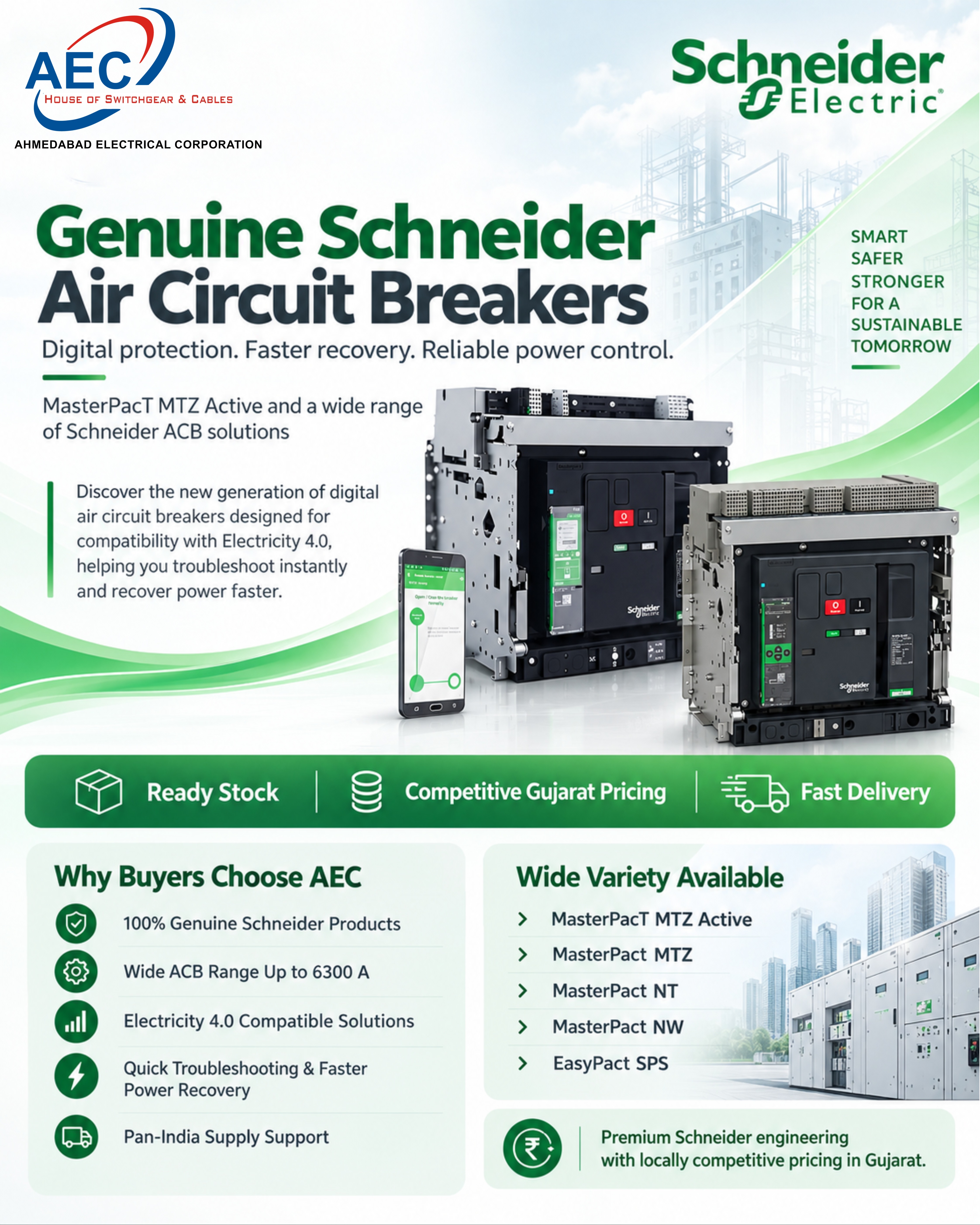
Schneider Electric’s India catalogue lists several high-current breaker families:
- MasterPacT MTZ Active: Protection solutions reaching 6300 A.
- MasterPacT MTZ: ACBs with MicroLogic X control units and digital capabilities.
- MasterPact NT: Published range of 630–1600 A.
- MasterPact NW: Published range of 800–6300 A.
- EasyPact SPS: Published range of 800–1600 A.
Availability, lifecycle status and configuration should be confirmed for the exact reference, particularly when replacing an existing breaker.
2. Match current capacity to the installation
Provide the design load current, system voltage, frequency and expected future expansion. Check the breaker’s usable current rating under actual enclosure and ambient conditions.
Distinguish between:
- Frame capacity: The physical breaker family’s capacity.
- Sensor or rated-current configuration: The selected breaker’s current capability.
- Protection settings: The thresholds established for the circuit.
A larger frame does not justify raising protection settings beyond the cable or busbar capacity. Final selection should follow the electrical design.
3. Check fault ratings and selectivity
Ask your designer for the prospective short-circuit current at the installation point. Compare it with the breaker’s ratings at the actual operating voltage.
- Icu: Ultimate short-circuit breaking capacity.
- Ics: Service short-circuit breaking capacity.
- Icw: Short-time withstand current for a specified duration.
Icw matters when protection coordination requires a time delay before the upstream breaker trips. Schneider explains that this rating is expressed with a duration, such as one second; the current value alone is incomplete.
4. Specify protection functions and pole arrangement
Select the trip unit against the approved protection study. Requirements may include long-time overload, short-time, instantaneous and earth-fault protection.
Confirm:
- Three-pole or four-pole construction.
- Neutral switching and neutral-protection requirements.
- Coordination with downstream breakers.
- Metering, communication and event-recording needs.
Digital functions vary by control unit and accessories. Request a configuration-specific quotation rather than assuming every feature is standard.
5. Choose fixed or drawout construction
A fixed breaker may suit installations where its maintenance arrangement is acceptable. Drawout construction can support removal and servicing while the chassis remains installed.
Before ordering, check panel dimensions, busbar connections, access clearances and chassis compatibility. For replacements, provide the existing breaker and chassis references.
Also specify control voltages for closing releases, shunt trips, undervoltage releases and charging motors where required. Include auxiliary contacts and interlocking requirements in the BOM.
6. Check genuine-product sourcing
Purchase through a traceable supply channel and request current dealer credentials. Match the product label, complete reference, invoice and approved specification.
- Retain purchase and delivery documents.
- Inspect for altered markings or unexplained damage.
- Use product-specific verification facilities where available.
- Refer doubtful items to Schneider Electric before installation.
Packaging or a QR code alone is insufficient proof. Schneider recommends authorised distribution when authenticity is a concern.
Complete Schneider switchgear enquiries
Alongside ACBs, Ahmedabad Electrical Corporation welcomes requirements for MCCBs, MCBs, RCCBs, contactors, overload relays, motor-protection devices, drives, PLCs, HMIs and control accessories.
Send a consolidated BOM for item-wise availability and pricing. Stock confirmation applies to each reference, including its trip unit and accessories.
Delivery across Gujarat’s industrial cities and GIDC clusters
We accept enquiries from major estates and smaller surrounding industrial areas:
- Ahmedabad: Vatva, Naroda, Odhav, Kathwada, Sanand, Dholka, Mandal and Viramgam.
- Gandhinagar–Mehsana: Chhatral, Kalol, Kadi, Gozaria, Visnagar and Kheralu.
- Surat: Sachin, Pandesara, Ichhapor, Katargam, Olpad and Bardoli.
- Valsad–Navsari: Vapi, Sarigam, Umbergaon, Gundlav, Pardi, Bilimora and Unai.
- Bharuch: Ankleshwar, Panoli, Jhagadia, Dahej, Saykha, Palej and Jambusar.
- Vadodara: Makarpura, Nandesari, Ranoli, Savli, Waghodia and Dabhoi.
- Central Gujarat: Halol, Godhra, Dahod, Nadiad, Vithal Udyognagar, Borsad and Petlad.
- Rajkot–Morbi: Aji, Bhaktinagar, Lodhika, Gondal, Jetpur, Rafaleshwar and Wankaner.
- Surendranagar: Wadhwan, Halvad, Thangadh, Chotila and Limbdi.
- Jamnagar–Bhavnagar: Shanker Tekri, Dhrol, Chitra, Vartej, Sihor and Palitana.
- Kutch: Gandhidham, Anjar, Bhuj, Mandvi, Mundra and Nakhatrana.
- Other centres: Junagadh, Veraval, Porbandar, Amreli, Patan, Palanpur, Deesa, Himmatnagar and Modasa.
Consult the GIDC directory for estate references and share your PIN code for delivery confirmation.
Request your Schneider ACB quotation
Our delivery targets are 4–5 days within Gujarat and 5–6 days to major Indian metros, subject to confirmed stock, order acceptance and transport serviceability. Special configurations have separate lead times.
How to Select Schneider Air Circuit Breaker for Industrial Use: 10 Buyer FAQs
1. How do I select a Schneider air circuit breaker for my industrial panel?
- Start with your load current, system voltage, prospective short-circuit current and protection requirements. Then confirm pole count, trip unit, mounting arrangement and accessories. Share your approved single-line diagram with Ahmedabad Electrical Corporation for a specification-based quotation.
2. Which Schneider ACB series should I enquire about?
- Schneider’s India catalogue lists MasterPacT MTZ Active, MasterPacT MTZ, MasterPact NT, MasterPact NW and EasyPact SPS. Selection depends on ratings, protection features and application needs. Confirm current availability and lifecycle status for the exact reference.
3. What is the difference between ACB frame size and trip-current setting?
- Frame size identifies the breaker’s construction and capacity limits. The selected sensor, rating configuration and trip unit determine available settings. Do not select by frame size alone: protection settings must coordinate with the load, cables, busbars and downstream devices.
4. Why are Icu, Ics and Icw important when selecting an ACB?
- Icu is ultimate short-circuit breaking capacity; Ics is service breaking capacity. Icw is the current the breaker can withstand for a specified time. Check these at the operating voltage, particularly where delayed tripping supports selectivity.
5. Should I choose a three-pole or four-pole Schneider ACB?
- Choose according to the earthing arrangement, neutral-switching requirements and approved circuit design. Four-pole construction may be required in certain source-transfer arrangements, but it is not automatically necessary for every installation. Confirm neutral protection separately.
6. Is a fixed or drawout ACB better for factory maintenance?
- A fixed ACB remains secured in its installation. A drawout ACB allows the breaker to be withdrawn from its compatible chassis for servicing. Compare maintenance access, shutdown requirements, panel space and cost. For replacements, verify both breaker and chassis compatibility.
7. Which trip-unit functions and accessories should I include in the quotation?
- Specify required overload, short-time, instantaneous and earth-fault protection. Add metering or communication requirements where needed. Include closing and tripping releases, charging motor, auxiliary contacts and interlocks, with their correct control voltages. Features vary by configuration.
8. How can I order a genuine Schneider ACB through Ahmedabad Electrical Corporation?
- Send the complete reference—or your approved specification—along with quantity and delivery address. Request applicable dealer credentials, an itemised invoice and warranty terms. Match product labels and supplied accessories with the order; packaging alone does not prove authenticity.
9. Do you supply Schneider ACBs across Gujarat’s major GIDC areas?
- We accept enquiries from Vatva, Naroda, Sanand, Chhatral, Kalol, Kadi, Makarpura, Savli, Ankleshwar, Dahej, Sachin, Pandesara, Vapi, Sarigam and Lodhika, plus surrounding industrial areas near Jamnagar, Bhavnagar and Gandhidham. Share your factory PIN code for delivery confirmation.
10. Why choose Ahmedabad Electrical Corporation for Schneider ACB procurement?
- We offer genuine-product sourcing, selected ready stock, consolidated quotations and coordinated dispatch. Delivery targets are 4–5 days within Gujarat and 5–6 days to major Indian metros, subject to confirmed availability, order acceptance and transport serviceability. Special ACB configurations have separate lead times.
Send your Schneider ACB requirement to Ahmedabad Electrical Corporation for configuration matching, stock confirmation and an item-wise quotation.
Contact Ahmedabad Electrical Corporation with your single-line diagram, fault level, current rating, pole configuration, trip-unit requirements and quantity for a quotation matched to your industrial panel.
Keywords